
A Costa Rica Real Estate Lawyer to Lead Your Property Due Diligence.
Simple Legal Consulting (SLC) defines the legal questions, coordinates the appropriate independent professionals, interprets their findings and converts the full review into practical advice for the purchase agreement, negotiation, closing or decision not to proceed.
Simple Legal Consulting (SLC) helps private clients, foreign families, sophisticated investors and developers in their negotiations and purchase decisions in Costa Rica.
Start with the legal question, then commission only the technical work the property actually requires.
01
Intentional
Structure
02
Collaborative
Energy
03
Expert
Facilitation
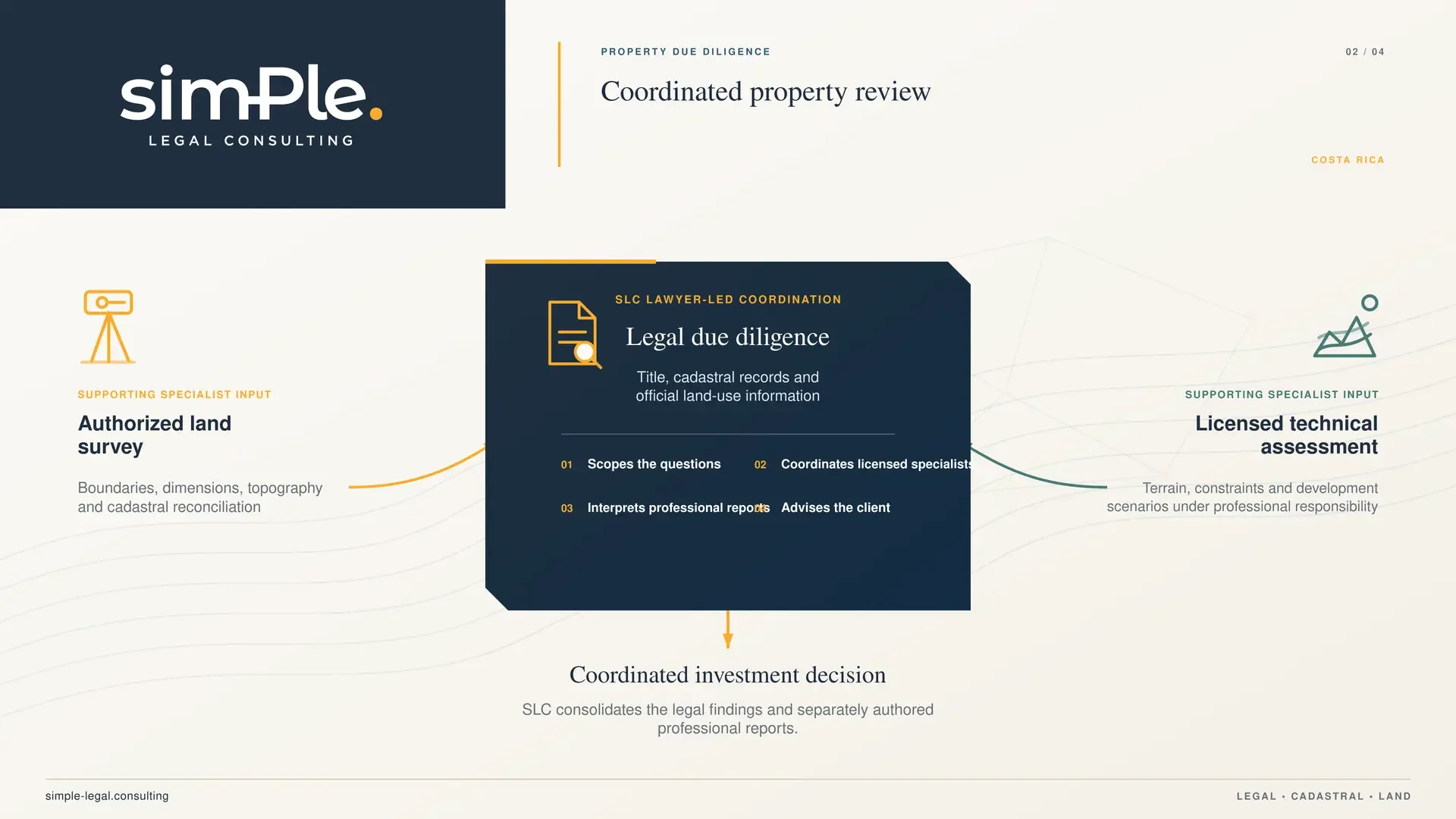
A useful due diligence process does not place the lawyer, surveyor and technical professionals in separate silos. The SLC lawyer leads the legal strategy, determines what information is needed, coordinates the right specialists and explains how every material finding affects the transaction.
Independent professionals remain responsible for their own technical work. The SLC lawyer remains the client's central point of contact and turns those findings into one coordinated property decision.
At Simple Legal Consulting (SLC) we offer legal services that help our clients buy properties safely in Costa Rica. We give the necessary peace of mind that they are making a smart decision and that their investment is well placed by conducting a carefully reviewed legal analysis of the conditions of the property, coordinating the technical professionals that are needed to answer the give inputs to the question that is essential for due dilligence: Is it smart and safe to make this investment?
Our role is to organize and coordinate the transaction, conduct the necessary legal review, identify potential risks, and support the due diligence, transfer, and registration process so that each client can move forward with clarity and confidence.
Our goal is to make real estate transactions in Costa Rica feel transparent, conscientious, honest, and as seamless as possible, helping buyers make informed decisions and helping owners connect with the right person so they can sell their property. We take pride in knowing that we are a trusted bridge between property buyers, sellers, agents, notaries, and technical professionals.
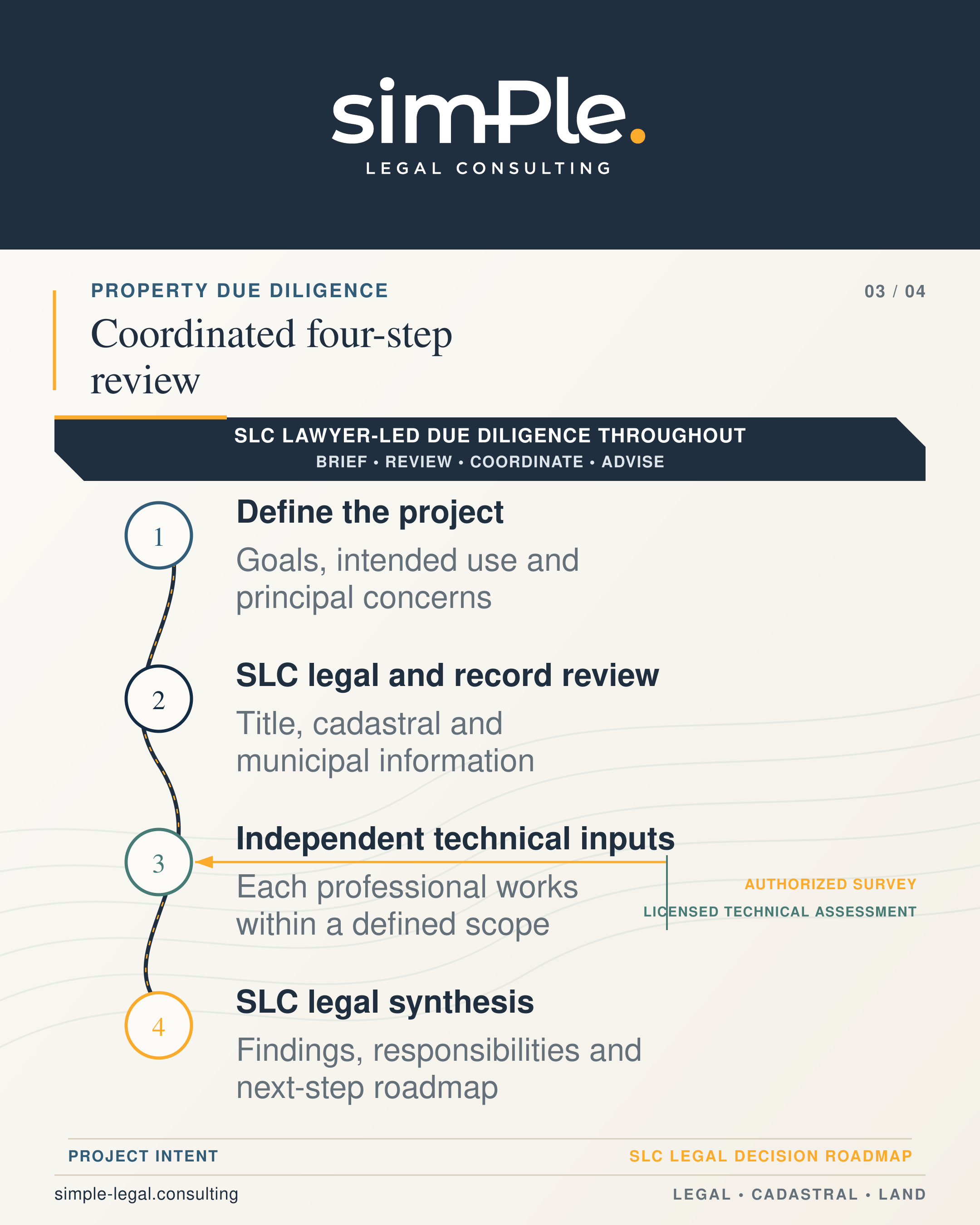
The Property Acquisition Process in Costa Rica. A real estate acquisition in Costa Rica generally involves two principal stages:
1. Lawyer-Led Legal Due Diligence, Coordinated Technical Review and Transaction Structuring
2. Purchase Closing and Property Registration
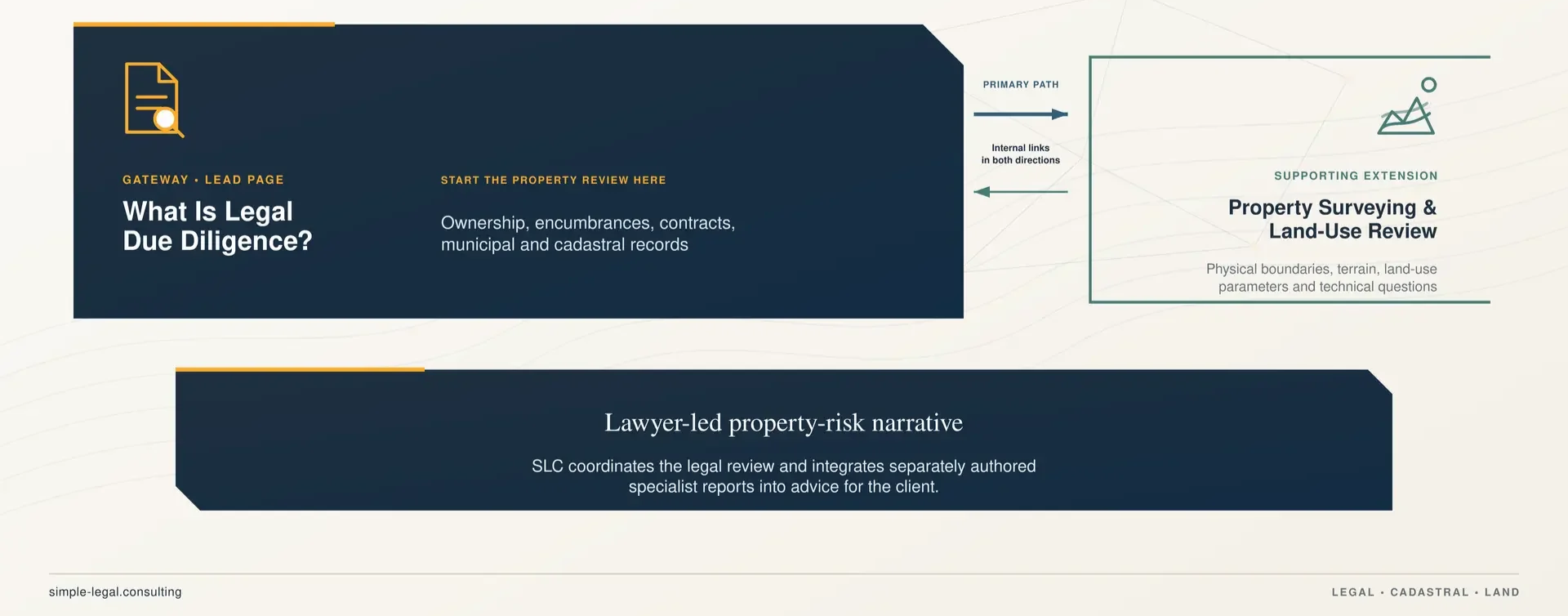
1. Lawyer-Led Legal Due Diligence, Coordinated Technical Review and Transaction Structuring
This is the investigation and risk-assessment stage of the acquisition. Simple Legal Consulting leads the legal review to determine whether the property is safe to acquire for the client’s intended purpose, under what conditions and with what contractual protections.
The review may involve title, Registry, cadastral, municipal, environmental and transactional information. When boundaries, terrain or development potential are relevant, SLC also coordinates independent professionals to examine the physical and technical condition of the property.
A title search alone cannot confirm that physical boundaries match the cadastral plan, that visible access is legally protected or that the client’s proposed project is compatible with the applicable land-use rules. Likewise, technical findings must be interpreted within the purchase agreement so that any discrepancy results in an appropriate legal response.
Why the lawyer leads the process
The scope of due diligence depends on the property and the client’s objectives. A condominium unit, rural parcel, coastal property and development site require different questions and professional assessments.
SLC leads the process by:
Defining the legal and transactional questions
Determining which matters require independent professional review
Coordinating the relevant specialists
Interpreting their findings within the legal due diligence
Connecting each material issue to a contractual or negotiation strategy
Advising the client whether and under what conditions to proceed
Independent professionals remain responsible for their own methodology, measurements, reports, plans and regulated technical conclusions.
Legal due diligence and transaction strategy
SLC reviews the legal and transactional condition of the property, identifies the principal risks and protects the client’s position through the purchase agreement.
Depending on the property and transaction, the review may include:
Title, ownership and registered encumbrances
Mortgages, liens, easements, annotations and limitations
Contract conditions and due diligence deadlines
Legal and physical access
Registry, cadastral and municipal records
Land-use information and property-specific restrictions
Taxes, condominium obligations and local charges
Available permits and documentation for existing structures
Legal interpretation of independent specialist findings
Transaction structure and proposed closing conditions
Coordinated surveying and cadastral review
When physical or cadastral verification is justified, SLC defines, with our internal experts team, the questions that must be answered and coordinates an independent licensed land survey professional.
Depending on the agreed scope, the survey professional may:
Verify dimensions, perimeter, area and boundaries
Locate reference points and visible physical features
Compare field conditions with cadastral and Registry information
Identify potential overlaps, gaps or encroachments
Prepare elevation data or contour information
Support procedures involving segregation, consolidation or area correction
The surveying professional prepares, signs and assumes responsibility for the resulting measurements, plans and technical reports.
Site-potential and specialist review
When the buyer intends to build, subdivide, operate a business or develop the property, SLC helps define the project objectives and coordinate the appropriate professional assessments.
These assessments may consider:
Topography, slopes and elevation changes
Rivers, streams, drainage patterns and other natural features
Vegetation and areas that may require environmental review
Legal and physical access
Land-use regulations
Setbacks, density and maximum site coverage
Apparent opportunities and constraints affecting the proposed project
Matters requiring environmental, engineering, geological, geotechnical or licensed architectural review
Municipal land-use information may establish maximum site coverage and other development parameters. However, these percentages do not necessarily represent the property’s final buildable area. Water availability, access, environmental restrictions, easements, drainage, slope, soil conditions and other regulatory requirements may further limit development.
Any site-potential review is preliminary and intended to support the buyer’s decision-making. It is not an approved design, permit drawing, engineering opinion or guarantee that a proposed project will be authorized.
From findings to a property decision
SLC integrates the legal review with the independently prepared technical findings and explains how each material issue may affect the purchase agreement, negotiation and closing.
Depending on the results and the rights established in the agreement, the client may decide to:
Proceed with the acquisition
Request additional information or verification
Require corrections before closing
Add contractual protections or closing conditions
Renegotiate the price, timing or other terms
Extend the due diligence period
Reconsider or withdraw from the transaction
At the beginning of the engagement, we clarify what the client intends to acquire, how the property will be used, what the seller or agent has represented, whether construction or subdivision is contemplated and which risks would materially affect the investment decision.

2. Purchase Closing and Property Registration
If the buyer decides to proceed after completing due diligence and the agreed closing conditions have been satisfied, the transaction moves to the closing stage.
The transfer is generally formalized through a public deed executed before a Costa Rican Notary Public. The notary prepares the legal instrument, verifies the formal requirements of the transaction and submits the deed to the National Registry.
The closing process may include:
Preparation or review of the purchase deed
Verification of the parties’ identities and legal capacity
Corporate authorizations, when applicable
Coordination with escrow providers, banks and other professionals
Confirmation that required corrections or releases have been completed
Execution of the public deed
Payment of the applicable transfer expenses
Submission of the deed to the National Registry
Follow-up until the transfer is registered
Once the deed has been properly registered, the transfer of ownership becomes effective against third parties.
From Due Diligence Findings to a Protected Closing
SLC does more than collect documents and specialist reports. We turn the findings into practical legal and transactional advice.
Depending on the results, we may advise the client to proceed, request corrections, obtain additional professional input, add contractual conditions, renegotiate the transaction, extend the review period or reconsider the acquisition.
If the client proceeds, SLC helps ensure that the material due diligence findings are properly addressed in the purchase agreement, closing documents and registration process.
What Our Real Estate Legal Due Diligence May Cover
-
We believe in keeping things simple, smart, and human. Every project starts with listening and ends with something we're proud to share.
-
We verify the registered owner and review liens, mortgages, annotations, easements, limitations, judicial claims and other registered matters that may affect ownership, use or transfer.
-
We review or prepare due diligence conditions, seller representations, deposits, escrow provisions, review deadlines, extension rights, correction obligations, closing conditions and withdrawal rights.
-
Visible access does not necessarily mean legal access. We review whether access is supported by a public road, registered easement, condominium right or another legally sufficient arrangement.
-
The review may include property taxes, municipal charges, luxury-home tax where applicable, condominium obligations and other amounts that should be clarified before closing.
-
For units, gated communities and private developments, we may review bylaws, restrictions, fees, governance documents, meeting records and obligations affecting the property.
-
When structures form part of the value, we review available municipal and permitting documentation and determine whether inspection or other professional assessment is appropriate..
-
Depending on the property, the review may consider watercourses, forest limitations, protected areas, coastal-zone rules and other restrictions requiring legal or specialist attention.
-
We advise on direct acquisition, the purchase of shares in a property-holding company or another structure, each of which presents distinct legal, tax, liability and diligence questions
Frequently Asked Questions
Still have questions? Take a look at the FAQ or reach out anytime. If you’re feeling ready, go ahead and apply.
-
We offer a range of solutions designed to meet your needs, whether you're just getting started or you are ready to move forward with the transaction. Everything is tailored to help you move forward with clarity and confidence. Best you can do is to schedule a meeting
-
Getting started is simple. Reach out through our contact form or schedule a call—we’ll walk you through the next steps and answer any questions along the way.
-
We combine a thoughtful, human-centered approach with clear communication and reliable results. We make it simple .
-
You can reach us anytime via our contact page, schedule a free call, or email. We aim to respond quickly—usually within one business day.
-
We offer fixed pricing based on project type and complexity. After an initial conversation, we’ll provide a transparent quote with no hidden costs.
-
Legal due diligence is the process of collecting, reviewing and interpreting the legal information that affects a proposed property acquisition. It may include title, ownership, liens, cadastral information, access, contracts, municipal matters, land use, taxes, condominium obligations and other property-specific risks.
-
The lawyer defines the legal questions, protects the buyer through the purchase agreement, reviews the public and transactional records, coordinates specialist work when necessary, and explains how each finding affects the acquisition. Technical professionals provide essential independent inputs, but the lawyer converts those inputs into contractual and transactional advice.
-
Foreigners may generally acquire titled property in Costa Rica. However, not every property interest is ordinary titled property. Coastal concessions, possession rights, corporate ownership and properties in regulated areas require specific review before the buyer relies on general assumptions.
-
A land-use certificate is municipal information addressing the uses and parameters applicable to a particular property. It may identify permitted or restricted activities, setbacks, coverage, density, height and other requirements. Its content depends on the municipality, zoning area, proposed activity and property.
Does a residential, commercial, agricultural or mixed-use category guarantee development potential?
No. A land-use category is only part of the analysis. Water availability, legal access, environmental restrictions, watercourses, forest limitations, coastal rules, utilities, slope, soil conditions and other approvals may further affect what can be developed.
-
SLC provides legal due diligence, project briefing, transaction strategy and professional coordination. Regulated architectural, engineering, surveying and other technical services are performed and issued by the appropriately licensed independent professional under that professional's own scope and responsibility but it is offered by SLC to facilitate it to clients.
-
An early site-potential review is a preliminary process that connects the client’s objectives with the available legal, cadastral, land-use and physical information.
Its purpose is to identify opportunities, constraints and unanswered questions before the client invests substantially in architectural design, engineering or permitting.
It is not a construction permit or a guarantee of development rights. It is a structured first assessment that helps determine which professionals, studies and institutional consultations may be required.
SLC can help you do this.
Let Us Identify What Must Be Verified
Send us the property listing, location, property identifier or cadastral plan, intended use, expected closing date and any draft offer or purchase agreement. We will identify the legal starting point and whether independent surveying or other professional input should be considered.
Request property due diligence